May 27, 2026
In today’s competitive automotive refinishing industry, color matching is no longer just a technical process — it directly affects profitability, customer satisfaction, and workshop efficiency.
Many body shops focus heavily on labor costs and paint material prices, but often overlook one hidden profit killer: poor color matching.
Even small color inaccuracies can lead to expensive rework, wasted materials, delayed delivery times, and dissatisfied customers.
Here are five major reasons why body shops lose profit on color matching — and how smarter refinishing systems can solve these problems.
________________________________________
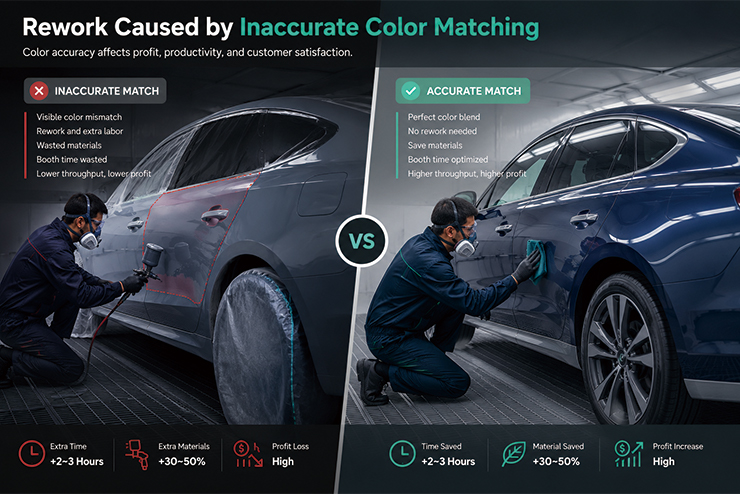
1. Rework Caused by Inaccurate Color Matching
One of the biggest profit losses comes from repainting jobs due to color mismatch.
When the repaired panel does not blend correctly with the original vehicle color, technicians must:
• Sand the panel again
• Remix paint
• Repaint and rebake
• Spend additional labor hours
This process not only wastes paint materials but also reduces workshop productivity.
In many cases, one failed color match can occupy a spray booth for several extra hours, delaying other jobs and reducing daily throughput.
For high-volume body shops, repeated rework quickly becomes a major operational cost.
Solution:
Using an advanced automotive color matching system with verified formulas and spectrophotometer support can significantly reduce mismatch rates.
________________________________________
2. Paint Material Waste Increases Operating Costs
Poor color matching often leads to excessive paint consumption.
Technicians may repeatedly adjust toners manually in an attempt to achieve a closer match. This trial-and-error process wastes:
• Basecoat
• Clearcoat
• Reducers
• Hardeners
• Mixing cups and consumables
Over time, the cost of wasted materials becomes substantial.
For body shops handling multiple repairs daily, even small paint losses per job can add up to thousands of dollars annually.
Solution:
A smart mixing system with accurate formulas helps technicians achieve the correct color faster, reducing unnecessary material waste.
________________________________________
3. Modern EV Colors Are More Difficult to Match
The rapid growth of electric vehicles has introduced a new challenge for body shops.
Modern EV colors often contain:
• Fine metallic particles
• Multi-layer pearl effects
• Special tinted clearcoats
• Unique flop and angle-changing effects
Many traditional paint databases are not updated quickly enough to cover newer EV colors from brands such as:
• BYD
• NIO
• XPENG
• Tesla
As a result, technicians spend more time searching for formulas or manually adjusting colors.
This increases labor costs and reduces repair efficiency.
Solution:
Choosing a refinishing system with continuously updated EV color databases and AI-assisted color matching technology can greatly improve repair accuracy.
________________________________________
4. Slow Repair Turnaround Reduces Shop Capacity
Time is money in the refinishing industry.
When technicians struggle with color matching, vehicle delivery times become longer. Delays affect:
• Workshop scheduling
• Customer satisfaction
• Insurance repair timelines
• Overall shop profitability
A body shop that spends extra hours correcting color problems completes fewer vehicles per week.
Lower throughput means lower revenue potential.
Solution:
Efficient color matching systems help technicians identify the correct formula quickly, reducing repair cycle time and increasing workshop productivity.
________________________________________
5. Customer Trust Is Easily Lost
Customers may not understand paint technology, but they immediately notice visible color differences.
Even a slight mismatch on a repaired panel can damage customer confidence in the repair quality.
Negative customer experiences can lead to:
• Complaints
• Refund requests
• Poor online reviews
• Loss of repeat business
In highly competitive local markets, reputation is extremely important for body shops.
Solution:
Consistent and accurate color matching improves finish quality, enhances customer trust, and strengthens long-term business relationships.
________________________________________
The Future of Color Matching Is Smart and Data-Driven
As automotive colors become more advanced, traditional manual color matching methods are becoming less efficient.
Modern body shops increasingly rely on:
• AI-assisted color matching
• Spectrophotometers
• Large global color databases
• EV-specific formulas
• Digital mixing systems
A smarter refinishing solution not only improves repair quality but also directly increases profitability.
________________________________________
Final Thoughts
Color matching problems are not just technical issues — they are business issues.
Body shops that reduce rework, minimize paint waste, and improve repair efficiency gain a major competitive advantage in today’s automotive refinishing mark
MEHR LESEN



 IPv6-Netzwerk unterstützt



 中文
中文